Vol II Ch IIc Excerpts Mein Kampf


Lies being taught;
Mein Kampf is unintelligible ravings of a maniac.
Now the Truth; Read and know. VOLUME II Chapter IIc: Duties of "people's State"
The second modification in the curriculum which the People's State will have to make is the following:
It is a characteristic of our materialistic epoch that our scientific education shows a growing emphasis on what is real and practical: such subjects, for instance, as applied mathematics, physics, chemistry, etc. Of course they are necessary in an age that is dominated by industrial technology and chemistry, and where everyday life shows at least the external manifestations of these. But it is a perilous thing to base the general culture of a nation on the knowledge of these subjects. On the contrary, that general culture ought always to be directed towards ideals. It ought to be founded on the humanist disciplines and should aim at giving only the ground work of further specialized instruction in the various practical sciences. Otherwise we should sacrifice those forces that are more important for the preservation of the nation than any technical knowledge. In the historical department the study of ancient history should not be omitted. Roman history, along general lines, is and will remain the best teacher, not only for our own time but also for the future. And the ideal of Hellenic culture should be preserved for us in all its marvellous beauty. The differences between the various peoples should not prevent us from recognizing the community of race which unites them on a higher plane. The conflict of our times is one that is being waged around great objectives. A civilization is fighting for its existence. It is a civilization that is the product of thousands of years of historical development, and the Greek as well as the German forms part of it.

A clear-cut division must be made between general culture and the special branches. To-day the latter threaten more and more to devote themselves exclusively to the service of Mammon. To counterbalance this tendency, general culture should be preserved, at least in its ideal forms. The principle should be repeatedly emphasized, that industrial and technical progress, trade and commerce, can flourish only so long as a folk community exists whose general system of thought is inspired by ideals, since that is the preliminary condition for a flourishing development of the enterprises I have spoken of. That condition is not created by a spirit of materialist egotism but by a spirit of self-denial and the joy of giving one's self in the service of others.

The system of education which prevails to-day sees its principal object in pumping into young people that knowledge which will help them to make their way in life. This principle is expressed in the following terms:
"The young man must one day become a useful member of human society." By that phrase they mean the ability to gain an honest daily livelihood. The superficial training in the duties of good citizenship, which he acquires merely as an accidental thing, has very weak foundations.

In reality this Republic has been allowed to exist undisturbed only by grace of its readiness and its promise to all and sundry, to pay tribute and reparations to the stranger and to put its signature to any kind of territorial renunciation. The rest of the world finds it just as a weakling who is always willing bend. The fact that the enemy likes this form of government is the worst kind of condemnation. They love the German Republic and tolerate its existence because no better instrument could be found which would help them to keep our people in slavery.

The People's State will have to fight for its existence. It will not gain or secure this existence by signing documents like that of the Dawes Plan. But for its existence and defence it will need precisely those things which our present system believes can be repudiated. The more worthy its form and its inner national being. the greater will be the envy and opposition of its adversaries. The best defence will not be in the arms it possesses but in its citizens. Bastions of fortresses will not save it, but the living wall of its men and women, filled with an ardent love for their country and a passionate spirit of national patriotism.

Therefore the third point which will have to be considered in relation to our educational system is the following:

The People's State must realize that the sciences may also be made a means of promoting a spirit of pride in the nation. Not only the history of the world but the history of civilization as a whole must be taught in the light of this principle. An inventor must appear great not only as an inventor but also, and even more so, as a member of the nation. The admiration aroused by the contemplation of a great achievement must be transformed into a feeling of pride and satisfaction that a man of one's own race has been chosen to accomplish it. But out of the abundance of great names in German history the greatest will have to be selected and presented to our young generation in such a way as to become solid pillars of strength to support the national spirit.

The subject matter ought to be systematically organized from the standpoint of this principle. And the teaching should be so orientated that the boy or girl, after leaving school, will not be a semi-pacifist, a democrat or of something else of that kind, but a whole-hearted German. So that this national feeling be sincere from the very beginning, and not a mere pretence, the following fundamental and inflexible principle should be impressed on the young brain while it is yet malleable: The man who loves his nation can prove the sincerity of this sentiment only by being ready to make sacrifices for the nation's welfare. There is no such thing as a national sentiment which is directed towards personal interests. And there is no such thing as a nationalism that embraces only certain classes. Hurrahing proves nothing and does not confer the right to call oneself national if behind that shout there is no sincere preoccupation for the conservation of the nation's well-being. One can be proud of one's people only if there is no class left of which one need to be ashamed. When one half of a nation is sunk in misery and worn out by hard distress, or even depraved or degenerate, that nation presents such an unattractive picture that nobody can feel proud to belong to it. It is only when a nation is sound in all its members, physically and morally, that the joy of belonging to it can properly be intensified to the supreme feeling which we call national pride. But this pride, in its highest form, can be felt only by those who know the greatness of their nation.
The spirit of nationalism and a feeling for social justice must be fused into one sentiment in the hearts of the youth. Then a day will come when a nation of citizens will arise which will be welded together through a common love and a common pride that shall be invincible and indestructible for ever.

While the People's State attaches the greatest importance to physical and mental training, it has also to consider, and no less importantly, the task of selecting men for the service of the State itself. This important matter is passed over lightly at the present time. Generally the children of parents who are for the time being in higher situations are in their turn considered worthy of a higher education. Here talent plays a subordinate part. But talent can be estimated only relatively. Though in general culture he may be inferior to the city child, a peasant boy may be more talented than the son of a family that has occupied high positions through many generations. But the superior culture of the city child has in itself nothing to do with a greater or lesser degree of talent; for this culture has its roots in the more copious mass of impressions which arise from the more varied education and the surroundings among which this child lives. If the intelligent son of peasant parents were educated from childhood in similar surroundings his intellectual accomplishments would be quite otherwise. In our day there is only one sphere where the family in which a person has been born means less than his innate gifts. That is the sphere of art. Here, where a person cannot just 'learn,' but must have innate gifts that later on may undergo a more or less happy development (in the sense of a wise development of what is already there), money and parental property are of no account. This is a good proof that genius is not necessarily connected with the higher social strata or with wealth. Not rarely the greatest artists come from poor families. And many a boy from the country village has eventually become a celebrated master. 

It does not say much for the mental acumen of our time that advantage is not taken of this truth for the sake of our whole intellectual life. The opinion is advanced that this principle, though undoubtedly valid in the field of art, has not the same validity in regard to what are called the applied sciences. It is true that a man can be trained to a certain amount of mechanical dexterity, just as a poodle can be taught incredible tricks by a clever master. But such training does not bring the animal to use his intelligence in order to carry out those tricks. And the same holds good in regard to man. It is possible to teach men, irrespective of talent or no talent, to go through certain scientific exercises, but in such cases the results are quite as inanimate and mechanical as in the case of the animal. It would even be possible to force a person of mediocre intelligence, by means of a severe course of intellectual drilling, to acquire more than the average amount of knowledge; but that knowledge would remain sterile. The result would be a man who might be a walking dictionary of knowledge but who will fail miserably on every critical occasion in life and at every juncture where vital decisions have to be taken. Such people need to be drilled specially for every new and even most insignificant task and will never be capable of contributing in the least to the general progress of mankind. Knowledge that is merely drilled into people can at best qualify them to fill government positions under our present regime.

A stock of knowledge packed into the brain will not suffice for the making of discoveries. What counts here is only that knowledge which is illuminated by natural talent. But with us at the present time no value is placed on such gifts. Only good school reports count.

Here is another educative work that is waiting for the People's State to do. It will not be its task to assure a dominant influence to a certain social class already existing, but it will be its duty to attract the most competent brains in the total mass of the nation and promote them to place and honour. It is not merely the duty of the State to give to the average child a certain definite education in the primary school, but it is also its duty to open the road to talent in the proper direction. And above all, it must open the doors of the higher schools under the State to talent of every sort, no matter in what social class it may appear. This is an imperative necessity; for thus alone will it be possible to develop a talented body of public leaders from the class which represents learning that in itself is only a dead mass. 

There is still another reason why the State should provide for this situation. Our intellectual class, particularly in Germany, is so shut up in itself and fossilized that it lacks living contact with the classes beneath it. Two evil consequences result from this: First, the intellectual class neither understands nor sympathizes with the broad masses. It has been so long cut off from all connection with them that it cannot now have the necessary psychological ties that would enable it to understand them. It has become estranged from the people. Secondly, the intellectual class lacks the necessary will-power; for this faculty is always weaker in cultivated circles, which live in seclusion, than among the primitive masses of the people. If instead of a Bethmann von Hollweg we had had a rough man of the people as our leader the heroic blood of the common grenadier would not have been shed in vain. The exaggeratedly intellectual material out of which our leaders were made proved to be the best ally of the scoundrels who carried out the November revolution. These intellectuals safeguarded the national wealth in a miserly fashion, instead of launching it forth and risking it, and thus they set the conditions on which the others won success.

It will be the task of the Peoples' State so to organize and administer its educational system that the existing intellectual class will be constantly furnished with a supply of fresh blood from beneath. From the bulk of the nation the State must sift out with careful scrutiny those persons who are endowed with natural talents and see that they are employed in the service of the community. For neither the State itself nor the various departments of State exist to furnish revenues for members of a special class, but to fulfil the tasks allotted to them. This will be possible, however, only if the State trains individuals specially for these offices. Such individuals must have the necessary fundamental capabilities and will-power.

Of course such a reform seems impossible in the world as it is to-day. The objection will at once be raised, that it is too much to expect from the favourite son of a highly-placed civil servant, for instance, that he shall work with his hands simply because somebody else whose parents belong to the working-class seems more capable for a job in the civil service. That argument may be valid as long as manual work is looked upon in the same way as it is looked upon to-day. Hence the Peoples' State will have to take up an attitude towards the appreciation of manual labour which will be fundamentally different from that which now exists. If necessary, it will have to organize a persistent system of teaching which will aim at abolishing the present-day stupid habit of looking down on physical labour as an occupation to be ashamed of.

The individual will have to be valued, not by the class of work he does but by the way in which he does it and by its usefulness to the community. This statement may sound monstrous in an epoch when the most brainless columnist on a newspaper staff is more esteemed than the most expert mechanic, merely because the former pushes a pen. But, as I have said, this false valuation does not correspond to the nature of things. It has been artificially introduced, and there was a time when it did not exist at all. The present unnatural state of affairs is one of those general morbid phenomena that have arisen from our materialistic epoch. Fundamentally every kind of work has a double value; the one material, the other ideal. The material value depends on the practical importance of the work to the life of the community. The greater the number of the population who benefit from the work, directly or indirectly, the higher will be its material value. This evaluation is expressed in the material recompense which the individual receives for his labour. In contradistinction to this purely material value there is the ideal value. Here the work performed is not judged by its material importance but by the degree to which it answers a necessity. Certainly the material utility of an invention may be greater than that of the service rendered by an everyday workman; but it is also certain that the community needs each of those small daily services just as much as the greater services. From the material point of view a distinction can be made in the evaluation of different kinds of work according to their utility to the community, and this distinction is expressed by the differentiation in the scale of recompense; but on the ideal or abstract plans all workmen become equal the moment each strives to do his best in his own field, no matter what that field may be. It is on this that a man's value must be estimated, and not on the amount of recompense received.

In a reasonably directed State care must be taken that each individual is given the kind of work which corresponds to his capabilities. In other words, people will be trained for the positions indicated by their natural endowments; but these endowments or faculties are innate and cannot be acquired by any amount of training, being a gift from Nature and not merited by men. Nature determines the form of this contribution. It is the duty of the individual to return to the community, zealously and honestly, what the community has given him. He who does this deserves the highest respect and esteem. Material remuneration may be given to him whose work has a corresponding utility for the community; but the ideal recompense must lie in the esteem to which everybody has a claim who serves his people with whatever powers Nature has bestowed upon him and which have been developed by the training he has received from the national community. Then it will no longer be dishonourable to be an honest craftsman; but it will be a cause of disgrace to be an inefficient State official, wasting God's day and filching daily bread from an honest public. Then it will be looked upon as quite natural that positions should not be given to persons who of their very nature are incapable of filling them.

Furthermore, this personal efficiency will be the sole criterion of the right to take part on an equal juridical footing in general civil affairs.
The present epoch is working out its own ruin. It introduces universal suffrage, chatters about equal rights but can find no foundation for this equality. It considers the material wage as the expression of a man's value and thus destroys the basis of the noblest kind of equality that can exist. For equality cannot and does not depend on the work a man does, but only on the manner in which each one does the particular work allotted to him. Thus alone will mere natural chance be set aside in determining the work of a man and thus only does the individual become the artificer of his own social worth.

At the present time, when whole groups of people estimate each other's value only by the size of the salaries which they respectively receive, there will be no understanding of all this. But that is no reason why we should cease to champion those ideas. Quite the opposite: in an epoch which is inwardly diseased and decaying anyone who would heal it must have the courage first to lay bare the real roots of the disease. And the National Socialist Movement must take that duty on its shoulders. It will have to lift its voice above the heads of the small bourgeoisie and rally together and co-ordinate all those popular forces which are ready to become the protagonists of a new WELTANSCHAUUNG.

Of course the objection will be made that in general it is difficult to differentiate between the material and ideal values of work and that the lower prestige which is attached to physical labour is due to the fact that smaller wages are paid for that kind of work. It will be said that the lower wage is in its turn the reason why the manual worker has less chance to participate in the culture of the nation; so that the ideal side of human culture is less open to him because it has nothing to do with his daily activities. It may be added that the reluctance to do physical work is justified by the fact that, on account of the small income, the cultural level of manual labourers must naturally be low, and that this in turn is a justification for the lower estimation in which manual labour is generally held.

There is quite a good deal of truth in all this. But that is the very reason why we ought to see that in the future there should not be such a wide difference in the scale of remuneration. Don't say that under such conditions poorer work would be done. It would be the saddest symptom of decadence if finer intellectual work could be obtained only through the stimulus of higher payment. If that point of view had ruled the world up to now humanity would never have acquired its greatest scientific and cultural heritage. For all the greatest inventions, the greatest discoveries, the most profoundly revolutionary scientific work, and the most magnificent monuments of human culture, were never given to the world under the impulse or compulsion of money. Quite the contrary: not rarely was their origin associated with a renunciation of the worldly pleasures that wealth can purchase. It may be that money has become the one power that governs life to-day. Yet a time will come when men will again bow to higher gods.

It is also one of the aims before our movement to hold out the prospect of a time when the individual will be given what he needs for the purposes of his life and it will be a time in which, on the other hand, the principle will be upheld that man does not live for material enjoyment alone. This principle will find expression in a wiser scale of wages and salaries which will enable everyone, including the humblest workman who fulfils his duties conscientiously, to live an honourable and decent life both as a man and as a citizen.

Only after the German people had become estranged from these ideals, to follow the material promises offered by the Revolution, only after they threw away their arms to take up the rucksack, only then--instead of entering an earthly paradise--did they sink into the purgatory of universal contempt and at the same time universal want.
That is why we must face the calculators of the materialist Republic with faith in an idealist REICH. ”
Adolf Hitler.

Bombing of Japan

BOMBING OF HIROSHIMA and NAGASAKI

Lies being taught; 
Atomic bombing of Hiroshima and Nagasaki was a necessity to end the war with Japan and prevent further American deaths.  They'll tell you that dropping the bombs "forced" Japan to surrender.  

Now the truth;
What most people don't know is that Japan had been attempting to make peace with US for months!  We already had her beat.  Her navy was practically gone, we had killed over 100,000 civilians in the bombing of Tokyo and the city was half destroyed.  Conventional bombs had destroyed over 40% of the urban areas in Japan's six greatest industrial cities.  A million Japanese civilians were dead.  Japan was already beat, and our military knew it.
https://www.youtube.com/watch?v=2Pxk4zy_SQw

Very short video of the bombings of Hiroshima and Nagasaki


According to historian Edwin J. Hoyt, "The fact is that as far as the Japanese militarists were concerned, the atomic bomb was just another weapon. The two atomic bombs at Hiroshima and Nagasaki were icing on the cake, and did not do as much damage as the firebombings of Japanese cities. The B-29 firebombing campaign had brought the destruction of 3,100,000 homes, leaving 15 million people homeless, and killing about a million of them. It was the ruthless firebombing, and Hirohito's realization that if necessary the Allies would completely destroy Japan and kill every Japanese to achieve "unconditional surrender" that persuaded him to the decision to end the war. The atomic bomb is indeed a fearsome weapon, but it was not the cause of Japan's surrender, even though the myth persists even to this day."

Historian Dennis D. Wainstock concludes that the bombings were not only unnecessary, but were based on a vengeful policy that actually harmed American interests.  He states that "By April 1945, Japan's leaders realized that the war was lost. Their main stumbling block to surrender was the United States' insistence on unconditional surrender. They specifically needed to know whether the United States would allow Hirohito to remain on the throne. They feared that the United States would depose him, try him as a war criminal, or even execute him." 

Wainstock further states that "unconditional surrender was a policy of revenge, and it hurt America's national self-interest. It prolonged the war in both Europe and East Asia, and it helped to expand Soviet power in those areas."

General Douglas MacArthur, Commander of US Army forces in the Pacific, stated on numerous occasions before his death that the atomic bomb was completely unnecessary from a military point of view: "My staff was unanimous in believing that Japan was on the point of collapse and surrender." 

General Curtis LeMay, who had pioneered precision bombing of Germany and Japan (and who later headed the Strategic Air Command and served as Air Force chief of staff), put it most succinctly: "The atomic bomb had nothing to do with the end of the war." 

Not exactly what you've been taught, is it
Just like in Germany
The bombing of Hiroshima and Nagasaki killed mostly civilians
Urban areas were selected that were then left untouched by conventional bombing so that the damage could be assessed after the atomic bombs were dropped

That's why we didn't drop the atom bomb on Tokyo -- conventional bombs had almost destroyed the city
The Target Committee stated that "It was agreed that psychological factors in the target selection were of great importance. Two aspects of this are (1) obtaining the greatest psychological effect against Japan and (2) making the initial use sufficiently spectacular for the importance of the weapon to be internationally recognized when publicity on it is released."

Sick

Little Boy" atomic bomb over Hiroshima

Fat Man" over Nagasaki


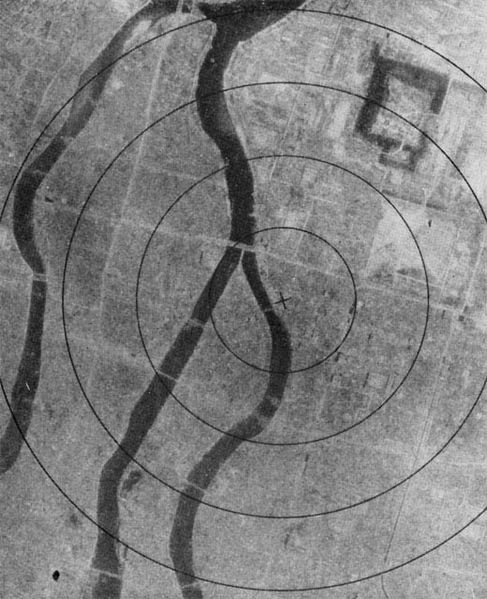
Hiroshima before and after.

Nagasaki before and after.

Hiroshima

Human shadow left on bank steps

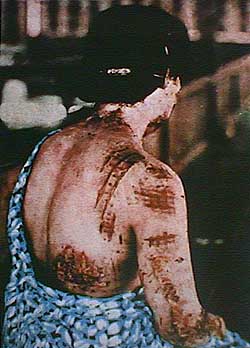
The pattern of her clothes seared to her skin

Charred boy

Piles of bodies at periphery of city

Impossible to identify

Notable Quotes:

Admiral William D. Leahy

(Chief of Staff to Presidents Franklin Roosevelt and Harry Truman)
"It is my opinion that the use of this barbarous weapon at Hiroshima and Nagasaki was of no material assistance in our war against Japan. The Japanese were already defeated and ready to surrender because of the effective sea blockade and the successful bombing with conventional weapons.
"The lethal possibilities of atomic warfare in the future are frightening. My own feeling was that in being the first to use it, we had adopted an ethical standard common to the barbarians of the Dark Ages. I was not taught to make war in that fashion, and wars cannot be won by destroying women and children."
- William Leahy, I Was There, pg. 441.

Herbert Hoover

On May 28, 1945, Hoover visited President Truman and suggested a way to end the Pacific war quickly: "I am convinced that if you, as President, will make a shortwave broadcast to the people of Japan - tell them they can have their Emperor if they surrender, that it will not mean unconditional surrender except for the militarists - you'll get a peace in Japan - you'll have both wars over."

Richard Norton Smith, An Uncommon Man: The Triumph of Herbert Hoover, pg. 347.

On August 8, 1945, after the atomic bombing of Hiroshima, Hoover wrote to Army and Navy Journal publisher Colonel John Callan O'Laughlin, "The use of the atomic bomb, with its indiscriminate killing of women and children, revolts my soul."

quoted from Gar Alperovitz, The Decision to Use the Atomic Bomb, pg. 635.

"...the Japanese were prepared to negotiate all the way from February 1945...up to and before the time the atomic bombs were dropped; ...if such leads had been followed up, there would have been no occasion to drop the [atomic] bombs."

- quoted by Barton Bernstein in Philip Nobile, ed., Judgment at the Smithsonian, pg. 142

Hoover biographer Richard Norton Smith has written: "Use of the bomb had besmirched America's reputation, he [Hoover] told friends. It ought to have been described in graphic terms before being flung out into the sky over Japan."

Richard Norton Smith, An Uncommon Man: The Triumph of Herbert Hoover, pg. 349-350.

In early May of 1946 Hoover met with General Douglas MacArthur. Hoover recorded in his diary, "I told MacArthur of my memorandum of mid-May 1945 to Truman, that peace could be had with Japan by which our major objectives would be accomplished. MacArthur said that was correct and that we would have avoided all of the losses, the Atomic bomb, and the entry of Russia into Manchuria."

Gar Alperovitz, The Decision to Use the Atomic Bomb, pg. 350-351.

General Douglas MacArthur

MacArthur biographer William Manchester has described MacArthur's reaction to the issuance by the Allies of the Potsdam Proclamation to Japan: "...the Potsdam declaration in July, demand[ed] that Japan surrender unconditionally or face 'prompt and utter destruction.' MacArthur was appalled. He knew that the Japanese would never renounce their emperor, and that without him an orderly transition to peace would be impossible anyhow, because his people would never submit to Allied occupation unless he ordered it. Ironically, when the surrender did come, it was conditional, and the condition was a continuation of the imperial reign. Had the General's advice been followed, the resort to atomic weapons at Hiroshima and Nagasaki might have been unnecessary."

William Manchester, American Caesar: Douglas MacArthur 1880-1964, pg. 512.

Norman Cousins was a consultant to General MacArthur during the American occupation of Japan. Cousins writes of his conversations with MacArthur, "MacArthur's views about the decision to drop the atomic bomb on Hiroshima and Nagasaki were starkly different from what the general public supposed." He continues, "When I asked General MacArthur about the decision to drop the bomb, I was surprised to learn he had not even been consulted. What, I asked, would his advice have been? He replied that he saw no military justification for the dropping of the bombThe war might have ended weeks earlier, he said, if the United States had agreed, as it later did anyway, to the retention of the institution of the emperor."

Norman Cousins, The Pathology of Power, pg. 65, 70-71.

Source; 

Vol II CH IIb Excerpts Mein Kampf


Lies being taught;
Mein Kampf is unintelligible ravings of a maniac.
Now the Truth; Read and know. VOLUME II Chapter IIb: functions of ‘State’
“Those who are physically and mentally unhealthy and unfit must not perpetuate their own suffering in the bodies of their children. Through educational means the State must teach individuals that illness is not a disgrace but an unfortunate accident which has to be pitied, yet that it is a crime and a disgrace to make this affliction all the worse by passing on disease and defects to innocent creatures out of mere egotism.
And the State must also teach the people that it is an expression of a really noble nature and that it is a humanitarian act worthy of admiration if a person who innocently suffers from hereditary disease refrains from having a child of his own but gives his love and affection to some unknown child who, through its health, promises to become a robust member of a healthy community. In accomplishing such an educational task the State integrates its function by this activity in the moral sphere. It must act on this principle without paying any attention to the question of whether its conduct will be understood or misconstrued, blamed or praised.
The WELTANSCHAUUNG which bases the State on the racial idea must finally succeed in bringing about a nobler era, in which men will no longer pay exclusive attention to breeding and rearing pedigree dogs and horses and cats, but will endeavour to improve the breed of the human race itself. That will be an era of silence and renunciation for one class of people, while the others will give their gifts and make their sacrifices joyfully.
That such a mentality may be possible cannot be denied in a world where hundreds and thousands accept the principle of celibacy from their own choice, without being obliged or pledged to do so by anything except an ecclesiastical precept. Why should it not be possible to induce people to make this sacrifice if, instead of such a precept, they were simply told that they ought to put an end to this truly original sin of racial corruption which is steadily being passed on from one generation to another. And, further, they ought to be brought to realize that it is their bounden duty to give to the Almighty Creator beings such as He himself made to His own image.
The State will first of all have to base its educational work not on the mere imparting of knowledge but rather on physical training and development of healthy bodies. The cultivation of the intellectual facilities comes only in the second place. And here again it is character which has to be developed first of all, strength of will and decision. And the educational system ought to foster the spirit of readiness to accept responsibilities gladly. Formal instruction in the sciences must be considered last in importance. Accordingly the State must start with the principle that a person whose formal education in the sciences is relatively small but who is physically sound and robust, of a steadfast and honest character, ready and able to make decisions and endowed with strength of will, is a more useful member of the national community than a weakling who is scholarly and refined. A nation composed of learned men who are physical weaklings, hesitant about decisions of the will, and timid pacifists, is not capable of assuring even its own existence on this earth.
Moltke's saying, that in the long run fortune favours only the efficient, is certainly valid for the relationship between body and spirit. A mind which is sound will generally maintain its dwelling in a body that is sound.
Accordingly, in the People's State physical training is not a matter for the individual alone. Nor is it a duty which first devolves on the parents and only secondly or thirdly a public interest; but it is necessary for the preservation of the people, who are represented and protected by the State. As regards purely formal education the State even now interferes with the individual's right of self-determination and insists upon the right of the community by submitting the child to an obligatory system of training, without paying attention to the approval or disapproval of the parents. In a similar way and to a higher degree the new People's State must organize its educational work in such a way that the bodies of the young will be systematically trained from infancy onwards, so as to be tempered and hardened for the demands to be made on them in later years. Above all, the State must see to it that a generation of stay-at-homes is not developed.
The work of education and hygiene has to begin with the young mother. The painstaking efforts carried on for several decades have succeeded in abolishing septic infection at childbirth and reducing puerperal fever to a relatively small number of cases. And so it ought to be possible by means of instructing sisters and mothers in an opportune way, to institute a system of training the child from early infancy onwards so that this may serve as an excellent basis for future development.
The People's State ought to allow much more time for physical training in the school. It is nonsense to burden young brains with a load of material of which, as experience shows, they retain only a small part, and mostly not the essentials, but only the secondary and useless portion; because the young mind is incapable of sifting the right kind of learning out of all the stuff that is pumped into it. Not a single day should be allowed to pass in which the young pupil does not have one hour of physical training in the morning and one in the evening; and every kind of sport and gymnastics should be included.
Generally speaking, the function of sport is not only to make the individual strong, alert and daring, but also to harden the body and train it to endure an adverse environment.
Our leadership in the purely intellectual sphere has always been brilliant, but as regards will-power in practical affairs our leadership has been beneath  criticism.
Of course education cannot make a courageous man out of one who is temperamentally a coward. But a man who naturally possesses a certain degree of courage will not be able to develop that quality if his defective education has made him inferior to others from the very start as regards physical strength and prowess. The army offers the best example of the fact that the knowledge of one's physical ability develops a man's courage and militant spirit. Outstanding heroes are not the rule in the army, but the average represents men of high courage. The excellent schooling which the German soldiers received before the War imbued the members of the whole gigantic organism with a degree of confidence in their own superiority such as even our opponents never thought possible. All the immortal examples of dauntless courage and daring which the German armies gave during the late summer and autumn of
1914, as they advanced from triumph to triumph, were the result of that education which had been pursued systematically. During those long years of peace before the last War men who were almost physical weaklings were made capable of incredible deeds, and thus a self-confidence was developed which did not fail even in the most terrible battles.
It is our German people, which broke down and were delivered over to be kicked by the rest of the world, that had need of the power that comes by suggestion from self-confidence. But this confidence in one's self must be instilled into our children from their very early years. The whole system of education and training must be directed towards fostering in the child the conviction that he is unquestionably a match for any- and everybody. The individual has to regain his own physical strength and prowess in order to believe in the invincibility of the nation to which he belongs. What has formerly led the German armies to victory was the sum total of the confidence which each individual had in himself, and which all of them had in those who held the positions of command. What will restore the national strength of the German people is the conviction that they will be able to reconquer their liberty. But this conviction can only be the final product of an equal feeling in the millions of individuals. And here again we must have no illusions.
The collapse of our people was overwhelming, and the efforts to put an end to so much misery must also be overwhelming. It would be a bitter and grave error to believe that our people could be made strong again simply by means of our present bourgeois training in good order and obedience. That will not suffice if we are to break up the present order of things, which now sanctions the acknowledgment of our defeat and cast the broken chains of our slavery in the face of our opponents. Only by a superabundance of national energy and a passionate thirst for liberty can we recover what has been lost.
Also the manner of clothing the young should be such as harmonizes with this purpose. It is really lamentable to see how our young people have fallen victims to a fashion mania which perverts the meaning of the old adage that clothes make the man.
Military training is excluded among us to-day, and therewith the only institution which in peace-times at least partly made up for the lack of physical training in our education. Therefore what I have suggested is all the more necessary in our time. The success of our old military training not only showed itself in the education of the individual but also in the influence which it exercised over the mutual relationship between the sexes. The young girl preferred the soldier to one who was not a soldier. The People's State must not confine its control of physical training to the official school period, but it must demand that, after leaving school and while the adolescent body is still developing, the boy continues this training. The present State, which does not interest itself in developing healthy men, has criminally neglected this duty. It leaves our contemporary youth to be corrupted on the streets and in the brothels, instead of keeping hold of the reins and continuing the physical training of these youths up to the time when they are grown into healthy young men and women.
In the People's State the army will no longer be obliged to teach boys how to walk and stand erect, but it will be the final and supreme school of patriotic education. In the army the young recruit will learn the art of bearing arms, but at the same time he will be equipped for his other duties in later life. And the supreme aim of military education must always be to achieve that which was attributed to the old army as its highest merit: namely, that through his military schooling the boy must be transformed into a man, that he must not only learn to obey but also acquire the fundamentals that will enable him one day to command. He must learn to remain silent not only when he is rightly rebuked but also when he is wrongly rebuked.
Furthermore, on the self-consciousness of his own strength and on the basis of that ESPRIT DE CORPS which inspires him and his comrades, he must become convinced that he belongs to a people who are invincible.
After he has completed his military training two certificates shall be handed to the soldier. The one will be his diploma as a citizen of the State, a juridical document which will enable him to take part in public affairs. The second will be an attestation of his physical health, which guarantees his fitness for marriage.
The People's State will have to direct the education of girls just as that of boys and according to the same fundamental principles. Here again special importance must be given to physical training, and only after that must the importance of spiritual and mental training be taken into account. In the education of the girl the final goal always to be kept in mind is that she is one day to be a mother.
It is only in the second place that the People's State must busy itself with the training of character, using all the means adapted to that purpose.
Of course the essential traits of the individual character are already there fundamentally before any education takes place. A person who is fundamentally egoistic will always remain fundamentally egoistic, and the idealist will always remain fundamentally an idealist. Besides those, however, who already possess a definite stamp of character there are millions of people with characters that are indefinite and vague. The born delinquent will always remain a delinquent, but numerous people who show only a certain tendency to commit criminal acts may become useful members of the community if rightly trained; whereas, on the other hand, weak and unstable characters may easily become evil elements if the system of education has been bad.
This is only one example among many. The deliberate training of fine and noble traits of character in our schools to-day is almost negative. In the future much more emphasis will have to be laid on this side of our educational work. Loyalty, self-sacrifice and discretion are virtues which a great nation must possess. And the teaching and development of these in the school is a more important matter than many others things now included in the curriculum. To make the children give up habits of complaining and whining and howling when they are hurt, etc., also belongs to this part of their training. If our youths, during their years in the primary schools, had had their minds crammed with a little less knowledge, and if instead they had been better taught how to be masters of themselves, it would have served us well during the years 1914-1918.
In its educational system the People's State will have to attach the highest importance to the development of character, hand-in-hand with physical training. Many more defects which our national organism shows at present could be at least ameliorated, if not completely eliminated, by education of the right kind.
Extreme importance should be attached to the training of will-power and the habit of making firm decisions, also the habit of being always ready to accept responsibilities.
In the training of our old army the principle was in vogue that any order is always better than no order. Applied to our youth this principle ought to take the form that any answer is better than no answer. The fear of replying, because one fears to be wrong, ought to be considered more humiliating than giving the wrong reply. On this simple and primitive basis our youth should be trained to have the courage to act.
It has been often lamented that in November and December 1918 all the authorities lost their heads and that, from the monarch down to the last divisional commander, nobody had sufficient mettle to make a decision on his own responsibility. That terrible fact constitutes a grave rebuke to our educational system; because what was then revealed on a colossal scale at that moment of catastrophe was only what happens on a smaller scale everywhere among us. It is the lack of will-power, and not the lack of arms, which renders us incapable of offering any serious resistance to-day. This defect is found everywhere among our people and prevents decisive action wherever risks have to be taken, as if any great action can be taken without also taking the risk. Quite unsuspectingly, a German General found a formula for this lamentable lack of the will-to-act when he said: "I act only when I can count on a 51 per cent probability of success." In that '51 per cent probability' we find the very root of the German collapse. The man who demands from Fate a guarantee of his success deliberately denies the significance of a heroic act. For this significance consists in the very fact that, in the definite knowledge that the situation in question is fraught with mortal danger, an action is undertaken which may lead to success. A patient suffering from cancer and who knows that his death is certain if he does not undergo an operation, needs no 51 per cent probability of a cure before facing the operation. And if the operation promises only half of one per cent probability of success a man of courage will risk it and would not whine if it turned out unsuccessful.
All in all, the cowardly lack of will-power and the incapacity for making decisions are chiefly results of the erroneous education given us in our youth. The disastrous effects of this are now widespread among us. The crowning examples of that tragic chain of consequences are shown in the lack of civil courage which our leading statesmen display.
The cowardice which leads nowadays to the shirking of every kind of responsibility springs from the same roots. Here again it is the fault of the education given our young people. This drawback permeates all sections of public life and finds its immortal consummation in the institutions of government that function under the parliamentary regime.
Just as the People's State must one day give its attention to training the will-power and capacity for decision among the youth, so too it must inculcate in the hearts of the young generation from early childhood onwards a readiness to accept responsibilities, and the courage of open and frank avowal.
The formal imparting of knowledge, which constitutes the chief work of our educational system to-day, will be taken over by the People's State with only few modifications. These modifications must be made in three branches.
First of all, the brains of the young people must not generally be burdened with subjects of which ninety-five per cent are useless to them and are therefore forgotten again. The curriculum of the primary and secondary schools presents an odd mixture at the present time. In many branches of study the subject matter to be learned has become so enormous that only a very small fraction of it can be remembered later on, and indeed only a very small fraction of this whole mass of knowledge can be used. On the other hand, what is learned is insufficient for anybody who wishes to specialize in any certain branch for the purpose of earning his daily bread.
The principal purpose of this copious instruction is frustrated, for that purpose cannot be to make the brain capable of learning by simply offering it an enormous and varied amount of subjects for acquisition, but rather to furnish the individual with that stock of knowledge which he will need in later life and which he can use for the good of the community. This aim, however, is rendered illusory if, because of the superabundance of subjects that have been crammed into his head in childhood, a person is able to remember nothing, or at least not the essential portion, of all this in later life. There is no reason why millions of people should learn two or three languages during the school years, when only a very small fraction will have the opportunity to use these languages in later life and when most of them will therefore forget those languages completely. To take an instance: Out of 100,000 students who learn French there are probably not 2,000 who will be in a position to make use of this accomplishment in later life, while 98,000 will never have a chance to utilize in practice what they have learned in youth. They have spent thousands of hours on a subject which will afterwards be without any value or importance to them. The argument that these matters form part of the general process of educating the mind is invalid. It would be sound if all these people were able to use this learning in after life. But, as the situation stands, 98,000 are tortured to no purpose and waste their valuable time, only for the sake of the 2,000 to whom the language will be of any use.
 A reform of particular importance is that which ought to take place in the present methods of teaching history. The essential features which are of real significance are not taught. It is left to the more or less bright intelligence of the individual to discover the inner motivating urge amid the mass of dates and chronological succession of events.
The subject matter of our historical teaching must be curtailed. For history must not be studied merely with a view to knowing what happened in the past but as a guide for the future, and to teach us what policy would be the best to follow for the future good of our own people. That is the real end; and the teaching of history is only a means to attain this end. The goal is completely forgotten. Do not reply that a profound study of history demands a detailed knowledge of all dates because otherwise we could not fix the great lines of development. That task belongs to the professional historians. But the average man is not a professor of history. For him history has only one mission and that is to provide him with such an amount of historical knowledge as is necessary in order to enable him to form an independent opinion on the political affairs of his own country. The man who wants to become a professor of history can devote himself to all the details later on. Naturally he will have to occupy himself even with the smallest details. Of course our present teaching of history is not adequate to all this. Its scope is too vast for the average student and too limited for the student who wishes to be an historical expert. 

To sum up: The People's State must reconstruct our system of general instruction in such a way that it will embrace only what is essential. Beyond this it will have to make provision for a more advanced teaching in the various subjects for those who want to specialize in them. It will suffice for the average individual to be acquainted with the fundamentals of the various subjects to serve as the basis of what may be called an all-round education. He ought to study exhaustively and in detail only that subject in which he intends to work during the rest of his life. A general instruction in all subjects should be obligatory, and specialization should be left to the choice of the individual.

In this way the scholastic programme would be shortened, and thus several school hours would be gained which could be utilized for physical training and character training, in will-power, the capacity for making practical judgments, decisions, etc.
Adolf Hitler.

Who is Responsible For World War 2 and 72 Million Dead?

                      THE FREEMEN Dear Brethren, World War 2, Main Causes and Adolf Hitler, Lies being taught; Hitler’s desire fo...